Things I've designed and built.
Merit.fyi
LaunchedFounders have no honest way to know which of their ideas deserve their time — friends flatter, and hype isn't evidence. Merit, live at merit.fyi, grades a startup idea in about ninety seconds across seven weighted dimensions, scored against the founder's actual skills, budget, and hours, with the full evaluation emailed to them. The methodology is public, most ideas land in the 50s and 60s, and every grade comes with a shareable score certificate. One shot to raise the score with better evidence; a $29 Deep Dive adds a freshly researched teardown, competitor intelligence, and a 30-day plan — delivered within the hour.

Clusi Control
In developmentHome and property service owners lose deals to scattered leads and slow follow-up. Clusi Control is a single command center — pipeline, CRM, estimates and proposals, financials, and prospect research in one place. It flags every lead going cold, forecasts revenue by close probability, simulates win-rate scenarios, and auto-generates insights on which jobs and channels actually make money — while a prospect radar scans your service territories, gathers source evidence, and pushes approved leads straight into the pipeline. A config system adapts the whole thing to each type of business without a rebuild.

Coastal Coat
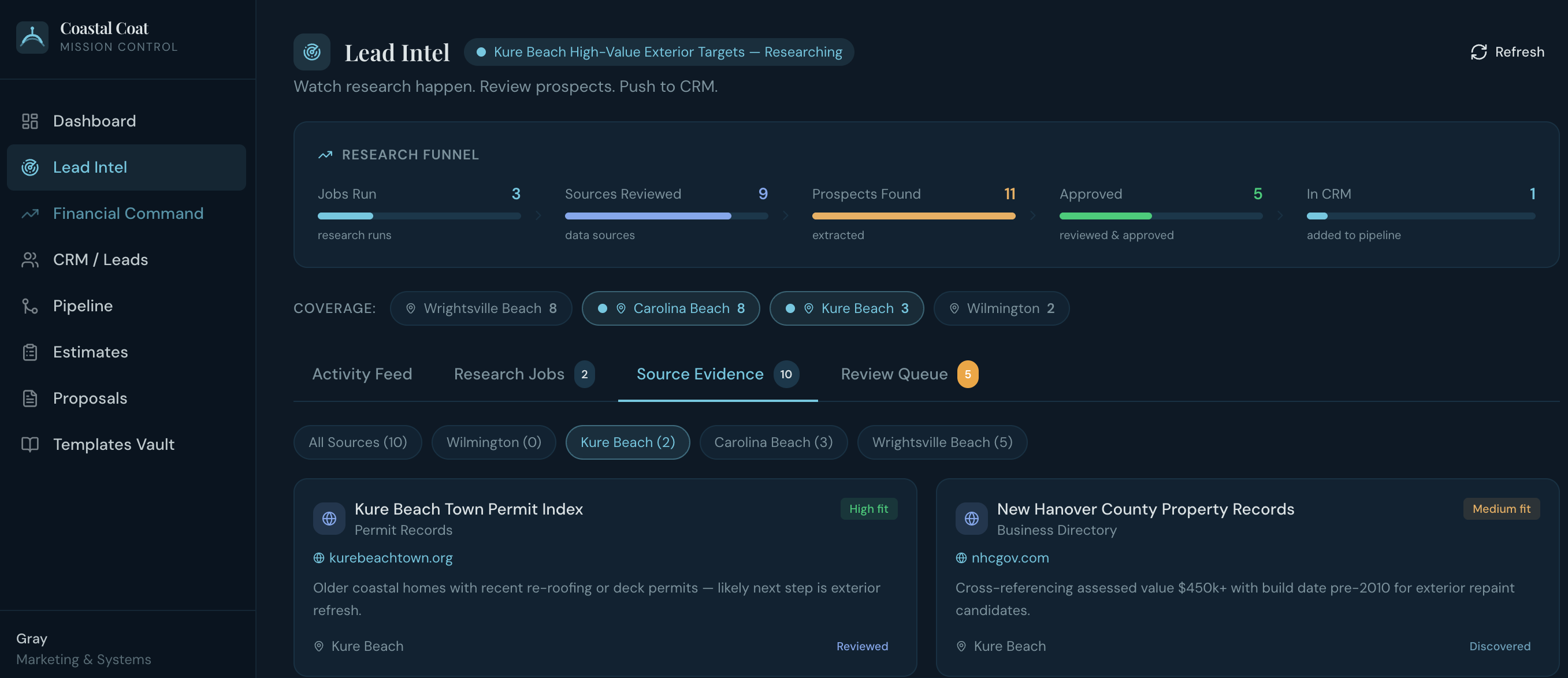
Origin of Clusi ControlAn early-stage residential painting company I co-founded. To find work for it, I built and deployed a lead-generation tool that researches a market, scores prospects by fit against real signals like permits and property records, and pushes the best ones into a CRM-ready pipeline. Watching it surface genuine high-value jobs is what made the bigger opportunity obvious — every home-service business needs this — so I generalized that tool into Clusi Control.